
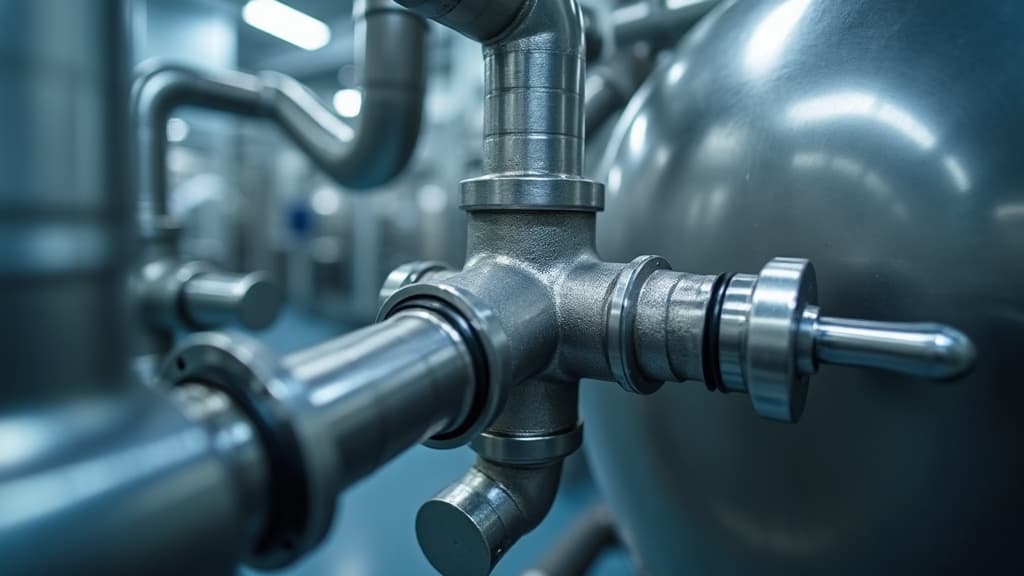
What is the difference between AISI 304 and AISI 316 Stainless Steel?
The two most frequently mentioned codes in food machine offers: AISI 304 and AISI 316. The difference is not only in price; it also affects the lifespan of your equipment and food safety.
Chemical Difference
Both are austenitic stainless steels. 304: ~18% chromium + 8% nickel. 316 adds ~2% molybdenum to this. Molybdenum significantly increases resistance to pitting corrosion in chloride (salt) and acidic environments.
Which Product for Which?
AISI 304 is sufficient:
- Water, milk, dry food, granular products
- General body, chassis, covers, conveyor
AISI 316 is recommended/required:
- Tomato paste and tomato products (acidic)
- Ketchup, pickles, vinegar, lemon-laden recipes
- Salted brine products (cheese, olives)
- Lines where CIP chemicals have intense contact
Practical Engineering Approach
Making the entire machine out of 316 is unnecessary cost; making it entirely from 304 poses a risk of early corrosion in acidic products. The right design is hybrid: product contact surfaces 316, structural parts 304. When comparing offers, always ask "which surface is made of which material" — the reason for the price difference between two offers is often this.
Certification and Traceability
Material quality is verified by certification, not declaration. Having material certificates (EN 10204 3.1) in the delivery documentation is important for audits and second-hand value.
Surface Treatment is as Important as Material
Even the same 316 can pose hygiene risks with poor welding and rough surfaces. It should be questioned whether the internal welds of food contact surfaces are ground/polished (Ra value).
Example Decision Table: Material Relative to Your Product
- Drinking milk line → contact surfaces 304 sufficient; if CIP circuit is intense, critical points 316
- Tomato paste/tomato line → evaporator, pasteurizer, and filling contact surfaces 316; chassis and covers 304
- Ketchup/sauce line → mixer tank inner surface and filling path 316; body 304
- Olive/pickle brine → from pump to filling, entire wet line 316 (chloride demands it)
- Dry food/granular filling → all surfaces 304 sufficient
- Fruit juice → for acidic fruits (pomegranate, sour cherry), contact surface 316 is recommended
This table is for guidance; final decision should be based on your product analysis values (pH, salt, temperature).
Material Checklist in Offer
- Is the distinction between "product contact surface" and "structural part" written in the offer?
- Will the EN 10204 3.1 material certificate be provided upon delivery?
- Are internal welds ground/polished (is the target Ra value specified)?
- Are gaskets and plastic contact parts food approved (FDA/EC 1935)?
- Is there a declaration of resistance to CIP chemicals?
How Corrosion Starts: Passive Layer and Chloride
What protects stainless steel is a few nanometers thick chromium oxide "passive layer" on its surface. Chloride ions (salt) penetrate this layer locally; invisible pinhole corrosion (pitting) begins and progresses underneath the layer. The advantage of molybdenum-containing 316 lies here: it enhances the passive layer's resistance to chloride. Practical outcome: 304 surfaces in brine and acidic products may show "no problem today, leaking two seasons later" behaviors; when damage is visible, it's too late. Moreover, incorrect cleaning triggers corrosion — leaving chloride-based bleach on stainless surfaces can pit even the highest-quality material. Cleaning instructions are as important as material selection.
Maintenance Note: Passivation
The passive layer is disrupted in areas of welding and mechanical damage; passivation processes with nitric/citric acid restore the layer. For new equipment delivery, ensure that welded areas are pickled + passivated; this process should also be repeated after major repairs. A single line in the offer stating "passivation included" can make a substantial difference in longevity on-site.
How to Verify at Delivery?
Do not let the material declaration remain on paper; three practical steps are sufficient at the acceptance stage. First, certificate matching: request from the manufacturer to mark the drawing where the casting numbers on the EN 10204 3.1 certificates match the critical parts on the equipment. Second, spot verification: measuring a few critical surfaces with a portable XRF (spectral analysis) device takes minutes and can be done by an independent inspection company for large investments. Third, control of the weld area: during FAT, visually and photographically confirm that internal welds are ground/passivated. These three steps take just a fraction of the total project cost; ignoring them will cost you years later as corrosion from incorrect material manifests.
Cleaning Chemicals and Material Compatibility
Even if the material is properly selected, the use of the wrong chemicals shortens its lifespan. Practical rules: do not leave chlorine-based bleaches on stainless surfaces (the most common DIY cause of pitting); do not exceed manufacturer-approved caustic/acid concentrations in CIP; conduct chloride analysis in plants using well water — high chloride water silently leaves traces on 304 surfaces. Request the cleaning instructions in writing from the equipment supplier and include them in operator training; the practical application of material science in the field is defined by these three habits.
Related Solutions
- Emulsion & Mixer Tank and Homogenizer — process equipment with 316 contact surfaces
- Tomato Paste & Tomato Processing Line — hybrid material approach in acidic product line
- You can see the standard of each equipment in the "Material" section on the machine pages: all machines
Frequently Asked Questions
Can 304 and 316 be visually distinguished?
No; their appearances are the same. Differentiation is done via certification and spectral analysis.
How much is the price difference?
There is a significant difference based on material; however, its impact on the total machine price remains manageable, especially when only contact surfaces are selected in 316.
What is 316L, and how is it different from 316?
It is the low carbon version; it enhances corrosion resistance in welding areas. It is preferred in heavily welded tank and pipe manufacturing.
Share the acid/salt profile of your product; let us evaluate for free which material is correct for which equipment. Just write your product on the offer form.