
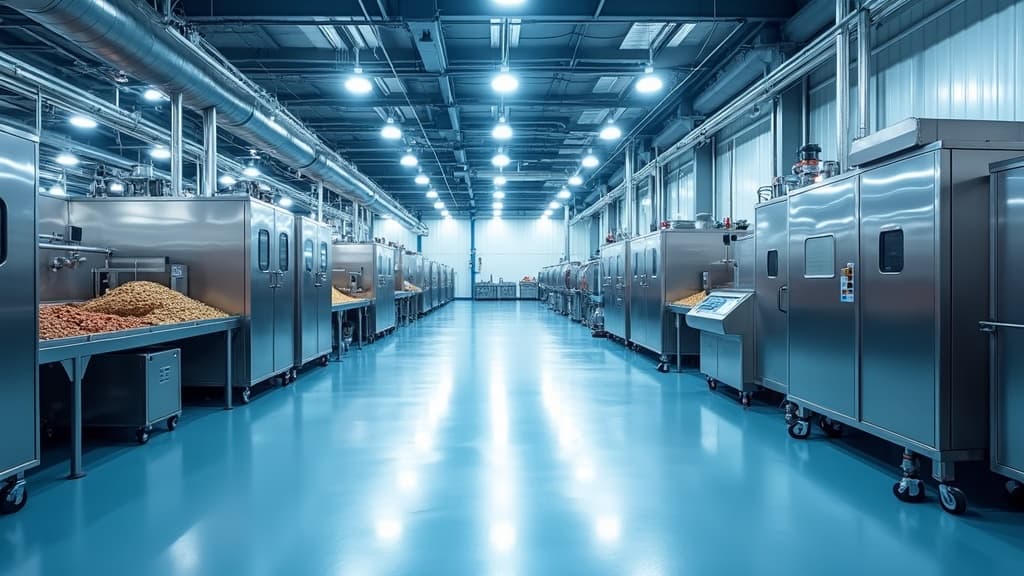
What is a Turnkey Food Facility?
A "turnkey" facility is a project model where the investor comes with an idea and leaves with a functioning, production-ready factory. The key difference from purchasing machinery is that the responsibility is centralized in one point.
Buying machinery ≠ Establishing a facility
A production line typically consists of 8 to 15 different equipment, often sourced from various manufacturers. When an investor purchases these individually, they may face inconsistent capacities, incompatible automation systems, and end up having to deal with the phrase, "that part was not in our scope" alone.
What does turnkey encompass?
- Process design and capacity calculation
- Layout project
- Equipment selection and procurement coordination
- Mechanical and electrical assembly management
- Piping, automation, and control panels
- Test production and commissioning
- Operator training and handover
Three benefits to the investor
1. Single point of accountability
There is no cycle of blame, such as "the filler blames the mixer"; the project manager resolves issues.
2. Budget discipline
The scope is defined upfront: which equipment, which auxiliary installations, which services are included. Surprise items decrease.
3. Time
The commissioning time is shortened by parallel procurement and site preparation.
What is turnkey not?
Building construction, land, and official permits are typically the investor's responsibility (expandable on a project basis). The model should be read as "production system included," not "everything included" — this clarity is healthy for both parties.
Sample project timeline
A typical flow for a medium-sized food line may vary according to project size:
- Week 1–3: Engineering pre-evaluation, capacity calculation, layout draft
- Week 3–6: Equipment list is clarified, contract and order
- Week 6–20: Equipment production (parallel site preparation: flooring, infrastructure, energy)
- Week 20–22: Factory Acceptance Tests (FAT) and shipment
- Week 22–28: Mechanical/electrical assembly, piping, automation
- Week 28–31: Test production, operator training, commissioning, and handover
The phase that most often extends the timeline is usually not the equipment, but the unprepared site. Running site preparation in parallel with equipment production is the most concrete time gain of the turnkey model.
What the investor needs to prepare (checklist)
- Product definition and target daily capacity
- Target market (domestic market / export) and packaging preference
- Existing building or land information: m², ceiling height, floor condition
- Electrical power, water source, and (if necessary) steam infrastructure status
- Target budget range and financing plan
- Planned commissioning date
These six pieces of information are sufficient for a healthy initial engineering pre-evaluation.
Risks of the model and the right questions
The turnkey model centralizes responsibility in one point; this is powerful but also means dependency on a single supplier. Managing risk lies in transparency:
- Is the equipment list written at the brand/model level or does it use the term "equivalent"?
- What criteria will the FAT (Factory Acceptance Test) be conducted under?
- Is post-commissioning support and spare part commitment included in the contract?
- Who is the project manager; is the single point of contact principle defined by name?
In a project where these questions have written answers, the risk of the model is largely mitigated.
Who is the right fit for the model?
The turnkey approach particularly adds value for three profiles. An investor establishing their first facility: as they lack experience in equipment compatibility and commissioning, a single point of accountability is their greatest insurance. An investor setting up abroad: centralized management of logistics, customs, and site coordination reduces time and risk. A growing manufacturer: bringing a new line online without halting existing production requires parallel project management. In contrast, large enterprises with strong technical teams that are used to acquiring equipment individually may operate more efficiently with a partial scope (just design + critical equipment) — the model is not dogma but a tool.
The investor's role in the process: 6 decision points
The turnkey model is not a "transfer everything, wait for the result" model; at critical moments of the project, the investor's quick and clear decision sets the timeline:
- Product sample and recipe approval: input for process design; delays here hold everything up
- Packaging decision: locks in filling-sealing-labeling triad
- Layout approval: building/infrastructure work begins based on this drawing
- FAT participation: seeing your machine in the manufacturing facility before shipment is the cheapest insurance
- Timely completion of site preparation: flooring, energy, water — these must be completed while equipment is on the way
- Operator training readiness: the team must be on-site during commissioning week
An experienced project manager will schedule these decisions in advance; the investor's job is to make quick decisions during uncertain moments. The most common reason for project delays is not technical issues but pending decisions.
Contract scope matrix
A one-page "who-does-what" matrix before signing eliminates most disputes at the start: line by line — building, flooring, steel construction, electrical main panel, distribution, steam boiler, compressed air, water treatment, equipment, assembly, piping, automation, commissioning, training — next to each item, write "contractor/investor/option." If this matrix is added to the proposal, you won't hear the phrase "that was not in our scope" throughout the project.
Related solutions
- Turnkey production lines — ketchup, sauce, dairy, filling, juice, and cold storage
- Our services — 8 service categories from project design to commissioning
- To review sample scope: Ketchup & Tomato Processing Line
Frequently Asked Questions
How does the process begin if I don’t have an existing building?
After the capacity and process are defined, a list of required area, height, and infrastructure will be created; your building project will be shaped accordingly.
Is partial scope possible?
Yes; partial models such as only process design + equipment supply or only commissioning are also implemented.
Does the process change for installations abroad?
The main flow remains the same; customs, logistics, and site team coordination are added to the timeline. Remote-access automation speeds up post-commissioning support.
How is the payment plan structured?
The typical model is based on stages: order advance, FAT approval, shipment, and commissioning. The phased plan protects both parties.
Share your facility idea; let’s define the scope together and start with an engineering pre-evaluation. The "Get Quick Quote" form is sufficient for the first step.