
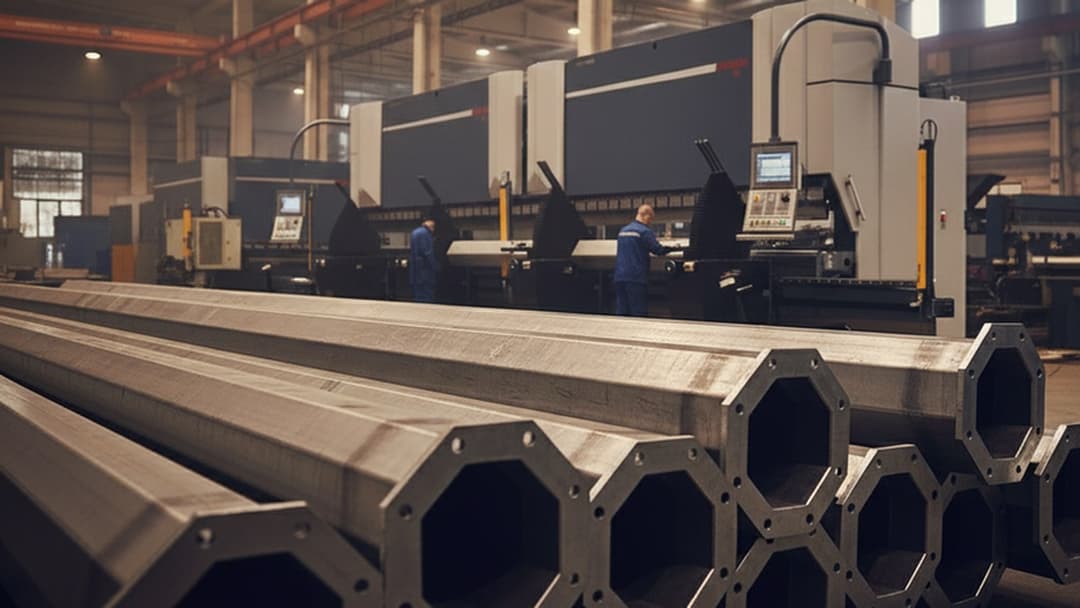
West Africa Metal Lighting Pole Facility — Surface Treatment Scenario Analysis
Study at a Glance
- Sector
- Production of metal lighting poles
- Country
- West Africa
- Investment Range
- €2.3 – €2.7 M / €5.5 – €6.5 M (depending on the scenario)
- Study Year
- 2026
An engineering study comparing the effect of surface treatment preference (hot-dip galvanizing with phosphate + paint) on the investment amount and payback period in the investment of a metal lighting pole production facility.
Investment Rationale
In lighting pole investments, the focus is usually on the production line; however, the item that most changes the investment amount and return period is the surface treatment preference. If the specification does not mandate hot-dip galvanizing, a phosphate + paint line allows achieving the same production capacity with significantly smaller capital and enables recovering the investment in a much shorter time.
Scope of Work
- Comparative Investment Analysis of Two Surface Processing Scenarios
- Determining the main equipment group and scope of the line
- Unit profit and break-even point calculation
- Comparison of Investment Costs and Payback Period
- Identification of market variables determining costs
Key Findings
The phosphate + paint scenario requires approximately 58% lower initial investment due to the absence of zinc cost.
Unit profit per unit is approximately 66% higher based on the same average selling price.
The required sales volume for investment payback decreases by 4 times.
The cutting, bending, and welding line is largely the same in both scenarios; the difference is concentrated in the surface treatment section.
The high-energy galvanizing pot that needs to operate continuously is taken out of service; it is replaced by a drying/baking oven.
Investment Budget
Approximate investment ranges by equipment group. These are grouped estimate bands, not line-item prices.
Decoiling-cutting line, plasma cutting, tandem press brake
Automatic longitudinal welding line
Phosphate pool line, drying oven, paint booth
Overhead crane systems
Annual operating cost
Excluded from this budget
- Logistics and freight
- Customs and duties
- Building and site infrastructure
- Permits and licences
- Working capital
Figures are EXW (ex-works) and based on references at the time of the study. Not a binding offer.
Purpose of the Study
This study, prepared for an investor planning a metal lighting pole production facility aimed at the West African market, reveals the extent to which a single engineering decision — the surface treatment method — changes the investment size and payback period.
The cutting, bending, and welding line in pole production is largely the same in both scenarios. The difference focuses on how corrosion protection is provided.
Two Scenarios
Scenario 1 — Hot Dip Galvanizing
An established solution in the industry. Poles are coated by being dipped into a molten zinc bath. It is an accepted method; however, zinc is the heaviest cost item in both the investment and operating sides of the facility.
Scenario 2 — Phosphate + Paint
Surface painting after phosphating. The zinc bath and high-energy galvanizing furnace are bypassed; instead, a drying/baking oven and a painting line are introduced.
Why Does Phosphate + Paint Require a Lower Investment?
- Raw Material: Zinc, the largest cost item of galvanizing, is completely eliminated.
- Input: Significantly lower-cost paint and phosphate chemicals replace it.
- Energy (galvanizing side): The high-energy galvanizing pot/furnace and its continuous operation requirement are eliminated.
- Energy (painting side): Only a drying/baking oven and air supply are needed; the cost is lower or similar.
- Labor and Maintenance: The line is largely the same. Consumables (filter, nozzle) are lower in cost.
Findings
The result of the study can be summarized in one sentence: the phosphate + paint scenario can be established with a smaller initial investment and leaves a higher profit per unit. When these two effects combine, the payback of the investment significantly accelerates.
- Initial investment is approximately 58% lower
- Profit per unit is approximately 66% higher
- The number of sales needed to reach the break-even point is 4 times lower
Facility Scope
The main equipment groups evaluated for the facility in the study are:
- Tandem press brake (with pole bending molds)
- Plasma cutting system
- Decoiling and cut-to-length line
- Automatic welding line
- In-factory crane systems
- Phosphate pool and painting facility
If you are planning a similar investment, you can check our turnkey production lines or request a direct quote.
Assumptions & Limitations
This study was prepared under the assumptions below. Results will differ under other conditions.
- Market reference
- The break-even analysis has been conducted based on the price level and sales assumptions of the Turkish market. Since pricing and volume will differ in the target market, it needs to be recalculated.
- Profit margins
- %30 (galvanized) and %50 (phosphate + paint) margins are working assumptions; they are not a commitment or guarantee.
- Scope Limitation
- The figures are based on equipment investment. Land, buildings, infrastructure, logistics, customs, and working capital are excluded.
- Specification Requirement
- Some tenders and technical specifications directly require hot-dip galvanizing. In such a case, Scenario 2 may not be applicable.
- Exchange rate assumption
- In currency conversions, an exchange rate of 1 USD = 0.92 EUR has been used; the current rate may vary this result.
Technical Specifications
| Product | Metal lighting / projector pole |
|---|---|
| Surface Processing — Scenario 1 | Hot-dip galvanizing |
| Surface processing — Scenario 2 | Phosphate + paint |
| Joint production line | Opening-cutting, plasma cutting, tandem press brake bending, automatic welding |
| Variables determining cost | Pole height, meat thickness, wind load |
| Key market risks | High logistics costs due to steel prices, exchange rates, energy expenses, and product volume |
Adapt this project to your own investment
We can prepare a preliminary study by tailoring the technical scope of this feasibility study to your target country, capacity, automation preference and delivery scope.
Request a Quote Based on This ProjectDownload the Full Report (PDF)
Leave your e-mail and download the report instantly.
10 pages · PDF
Download the Full Report (PDF) (opens in a new tab)Frequently Asked Questions
Has this facility been established?
No. The study has been prepared at the feasibility and engineering stage; it does not describe an established facility.
Is galvanization always the wrong choice?
No. Some specifications require hot-dip galvanization. The study shows how the investment economy changes if such a requirement does not exist.
Do these figures fit my project?
It may not align directly. The margin and breakeven quantity should be recalculated based on the price level and volume of the target market.
Can two methods be implemented on the same line?
Since a large part of the production line is common, it is technically possible; however, establishing the surface treatment section twice increases the investment. This study compares the two methods alternatively.