
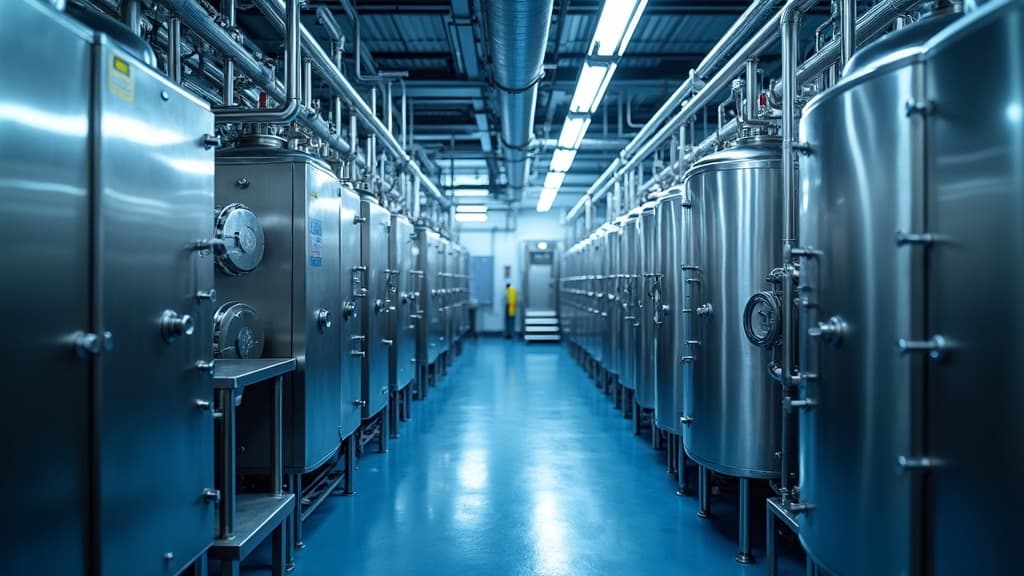
What to Consider When Choosing a Milk Pasteurization Line?
Dairy processing facilities provide a stable business model for investors with a daily and steady flow of raw materials. The right line selection is about establishing a balance between microbial safety, energy costs, and product diversity.
1. Accurately determine the daily milk quantity
Line capacity is defined in L/hour, but the investment decision should be based on the daily collected milk. A typical balance for 10,000 L/day of milk is a 2,000–3,000 L/hour pasteurizer; the line operates for 4–5 hours a day, with the remaining time allocated for cleaning and maintenance.
2. Heat recovery determines operating costs
Modern plate pasteurizers provide heat recovery rates of up to 90%. This ratio reflects the bill for steam consumed each day: low-recovery cheap equipment will cost the difference in energy over a few years.
3. Homogenization decision
A homogenizer is a quality standard for drinking milk and yogurt; it prevents cream formation by breaking down fat globules. However, it is often neglected in cheese-focused facilities. Make your decision according to your product range.
4. Design open to product diversity
Today drinking milk, tomorrow yogurt and buttermilk: if process tanks and pipelines are designed to be diversified from the outset, additional products can be added with small investments.
5. Filling options
Bag filling is the most economical entry; PET bottle market perception is high; bag-in-box is suitable for corporate sales. The filling type must be compatible with the pasteurizer output speed.
Example capacity calculation: 10,000 liters of milk per day
- Pasteurizer: 2,500 L/hour class → 10,000 L processed in 4 hours per day
- Remaining shift: CIP (≈ 1.5 hours), product transitions, and maintenance
- Raw milk acceptance: if it comes all at once in the morning, a 10,000 L refrigerated acceptance/storage tank; if it comes in two phases, 2 × 5,000 L
- Ice water group: proportional capacity for the pasteurizer cooling zone to milk flow rate; the homogenizer is connected in series at the same flow rate (2,500 L/hour)
- Filling: 10,000 units/day in 1 L bags/bottles → 1,700 units/hour filling class in ≈ 6 effective hours
This calculation links the number of tanks, ice water load, and filling speed in a single chain. Look at the rest of the chain before enlarging any link.
Technical checklist before the offer
- Daily collected milk (L/day), seasonal fluctuations, and growth expectations
- Product range: drinking milk / yogurt / buttermilk / cheese — which ones, in what order
- Is homogenization required (yes for drinking milk and yogurt, generally no for cheese)
- Filling packaging: bag / PET bottle / bag-in-box and daily quantity
- Raw milk acceptance scenario: how many times, at what hour, at what temperature
- Ice water and steam infrastructure
- CIP chemical storage and wastewater neutralization plan
- Cold room capacity (for finished products)
Common mistakes
- Not thinking daily but hourly: a 2,000 L/hour pasteurizer is not "2,000 L per day"; but on the flip side, choosing a line twice as large just because the daily milk will be processed in 4 hours is also wasteful of capital.
- Sacrificing heat recovery in negotiations: the price difference between two offers often arises from reducing the regeneration section; the difference will be paid in the first year with the steam bill.
- Choosing a small ice water group: a facility that cannot lower the pasteurizer output to 4 °C starts compromising on product safety.
- Forgetting the CIP chemical storage and neutralization: caustic and acid; storage comes with a dosing and wastewater neutralization plan.
Energy efficiency: what does regeneration yield?
In a plate pasteurizer, raw milk is pre-heated with pasturized hot milk (regeneration). In a system with 90% regeneration, approximately 61 degrees of the rise from 4 °C to 72 °C is "free"; steam is only consumed for the last few degrees. In a line with a capacity of 2,500 L/hour, this means significant steam savings in every production hour and far outweighs the equipment price difference over the years. The question to ask in an offer is clear: "What is your regeneration rate?"
Product range economics: the value-added ladder from milk to yogurt
Drinking milk generates volume but has a thin unit margin; value-added increases as one climbs the ladder of milk processing. Yogurt is produced by adding incubation tanks and cup/bucket filling to the same pasteurization infrastructure; buttermilk is a natural extension of the yogurt line and fills the capacity in summer months. Cheese requires a separate expertise and aging area; however, the evaluation of whey — whether as a beverage, curd, or animal feed — is the facility's hidden income item. The right strategy in most regions is as follows: establish cash flow with the first phase of drinking milk + buttermilk, and grow the margin with yogurt in the second phase. This ladder can be climbed with small additions if the pipeline and tank layout are designed to be diversified from day one; if thought of later, each step becomes a new project.
The raw milk collection network is also part of the facility
No matter how modern the line is, if there is no daily regular and cooled raw milk flow, the facility cannot operate. Collection centers, cooling tanks, and milk tanker planning must be discussed at the same table as the capacity decision. A pricing and quality (fat/protein/bacteria) based contract model with producers serves as a strong foundation for both raw material security and bank financing files.
Related solutions
- Dairy Processing & Pasteurization Line — complete line and capacity options
- Pasteurizer — heat recovery plate system
- Homogenizer — non-cream forming drinking quality
- Plate Heat Exchanger — for heating/cooling steps
Frequently Asked Questions
Is a CIP system mandatory?
Yes. Daily chemical cleaning (caustic + acid) in the milk line is a prerequisite for microbial safety; it is not sustainable with manual cleaning.
Does the cold chain also fall under the scope?
Raw milk acceptance tanks, ice water group, and cold room needs must be planned together in the preliminary assessment.
Can yogurt and buttermilk be added to the same line later?
Yes; it can be expanded by adding incubation tanks and related filling. If the pipeline and valve group are designed to be diversified from the outset, additional investments remain small.
Does raw milk quality impact the line?
Directly. High acidity and total bacterial load in milk reduce pasteurization efficiency and shelf life; a routine for quick tests (alcohol, acidity) should be planned for acceptance.
Share your daily milk quantity and target products; let’s clarify the line configuration and facility needs together. Start by marking your capacity option by requesting a quote for "This Line" on the line page.