
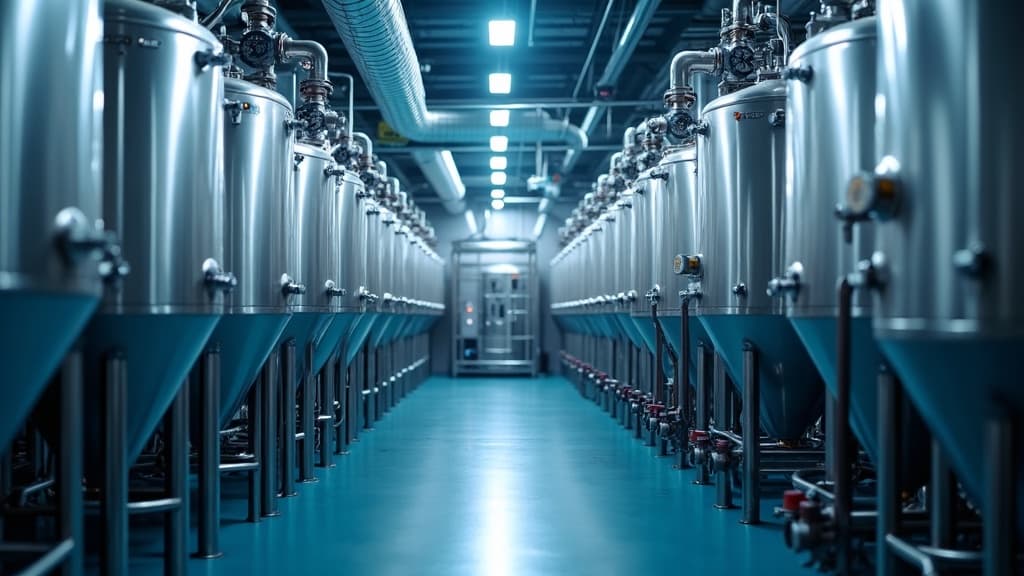
What is a CIP System and Why is it Important in Food Facilities?
CIP (Clean-In-Place) is a closed-loop washing system for tanks, pipes, and filling machines that does not require disassembly. It is the infrastructure of hygiene in a modern food facility and one of the first systems to be examined during inspections.
How does it work?
The CIP unit consists of water and chemical tanks, a pump and heater, and conductivity/temperature sensors. The cleaning liquid is circulated through the process line at a certain speed and temperature.
Typical CIP stages
- Pre-rinse: removes coarse product residues
- Caustic wash (1-2% NaOH, 70-80 °C): dissolves fat and protein
- Intermediate rinse
- Acid wash (nitric/phosphoric): removes mineral deposits (milk stones)
- Final rinse and (if necessary) disinfection
The acid step is routine in milk lines; caustic-heavy programs are prioritized in sauce lines.
Why isn't manual cleaning sufficient?
- The insides of pipes and tank roofs are inaccessible by hand; biofilm forms in these areas.
- Manual cleaning is as clean as whoever did it; CIP is repeatable — temperature, time, and chemistry are the same every time.
- Record: sensor data is logged; there is an answer to the question "when and at what temperature was it washed" during inspections.
Justification for Investment
CIP reduces operating costs by using reclaimed water and chemicals, shortens cleaning time, increasing production hours, and decreases product recall risk. Calculate not the total cost, but the total risk.
Spray ball and design details
For tanks to be CIP-able, properly positioned spray balls, valving that leaves no dead volume, and a 1% inclined piping are required. CIP is not an add-on device; it is part of the line design.
Example sizing: 5,000 L tank + 200 m pipeline
The CIP unit for a medium-sized milk/sauce plant is roughly shaped as follows:
- Target flow rate for pipe cleaning: 1.5-2.0 m/s → DN50 line approx. 8-12 m³/hour pump flow rate
- Tank cleaning: flow rate typically proportional to tank circumference per spray ball; a single spray ball is generally sufficient for a 5,000 L vertical tank
- CIP tank volumes: typical starting volume of 3 × 1,000-1,500 L for caustic + acid + recovery water
- Heating: plate heat exchanger or electric/steam heater for 70-80 °C caustic
- Program duration: pre-rinse → caustic → rinse → acid → final rinse approx. 60-90 minutes
These values are clarified in the project according to line length and number of tanks; however, locations left with the approach "CIP is added afterward" often prove insufficient.
CIP planning checklist
- Circuits to be cleaned: tanks, process lines, filling machine — how many separate circuits
- Product profile: fatty/protein-rich (caustic-heavy), does it form mineral deposits (acid step)
- How many cleaning cycles are needed per day (number of product transitions)
- Desired level of water recovery and wastewater neutralization
- Chemical storage area and operator safety equipment
- Sensor/logging needs (for auditing and traceability)
Beyond CIP: disinfection and SIP
CIP chemical cleaning is a solution; in some product groups, an additional disinfection step is added. Options include: hot water sanitation (85-90 °C circulation), cold disinfectants like peracetic acid, or steam sterilization (SIP - Sterilize-In-Place). SIP is standard in aseptic filling lines; hot water sanitation is usually sufficient for classic pasteurized products. The right question is not "which is best," but "which one does my product's shelf life target require?"
Water and chemical economy
Well-designed CIP uses the final rinse water in the next pre-rinse (recovery tank) and evaluates caustic solution multiple times with conductivity control. A rough comparison: in a non-recovery simple system, each cycle consumes full water + full chemical; in a recovery system, water consumption significantly decreases, and chemicals can be used for weeks by monitoring concentration. In a facility performing 2-3 cycles a day, this difference becomes a visible line item in the annual operating budget. Check whether the recovery tank and conductivity sensor are included in the offer.
Verification: how do you know it's clean?
The operation of CIP and proof of cleanliness are separate topics, and the latter is questioned during inspections. Verification is established on three layers. The first layer is process recording: logging the temperature, time, and conductivity data of each cycle — modern CIP panels do this automatically. The second layer is rapid tests: ATP measurement from swabs taken at critical points, providing "clean/not clean" results in minutes and should be included in shift routines. The third layer is periodic microbiological analysis: sampling according to plan from final rinse water and product contact surfaces. When these three layers are combined in a file, you shift from "cleaning claim" to "record" for both customer inspections and official controls. When setting up a new line, request the integration of data recording (logging) capability in the CIP panel in writing — retrofitting is always more expensive than including it from the start.
Common CIP mistakes
The three most common errors encountered in the field are simple: low circulation speed (pump is correct but line diameter has been increased — the mechanical cleaning effect is lost below 1.5 m/s), chemical concentration being prepared "by eye" (manual dosing despite having a conductivity sensor), and not noticing spray ball blockage (silent contamination at the tank top). A simple monthly CIP performance check — flow, concentration, temperature, spray ball observation — captures all three.
Related Solutions
- Milk Processing & Pasteurization Line — typical line where CIP is mandatory
- Sauce, Mayonnaise & Ketchup Line — CIP planning during recipe transitions
- Pasteurizer and Plate Heat Exchanger — thermal processing equipment with CIP integration
Frequently Asked Questions
Is CIP necessary in a small facility?
It is recommended for all scales processing dairy and acidic products; compact single-tank CIP units are economical for small lines.
How much production time does CIP take away?
Typical program length is 45-90 minutes; it is scheduled during planned shift breaks.
Do CIP chemicals leave residues in the product?
No, provided there is proper final rinse and phase separation using conductivity sensors; the sensor ends the rinse by measuring that no chemicals remain in the water. Therefore, a system with sensors should be preferred.
Let us size your CIP needs according to your product; we also report the cleaning scenario in the preliminary assessment. Just specifying your product and the number of tanks is sufficient when requesting a quote.