
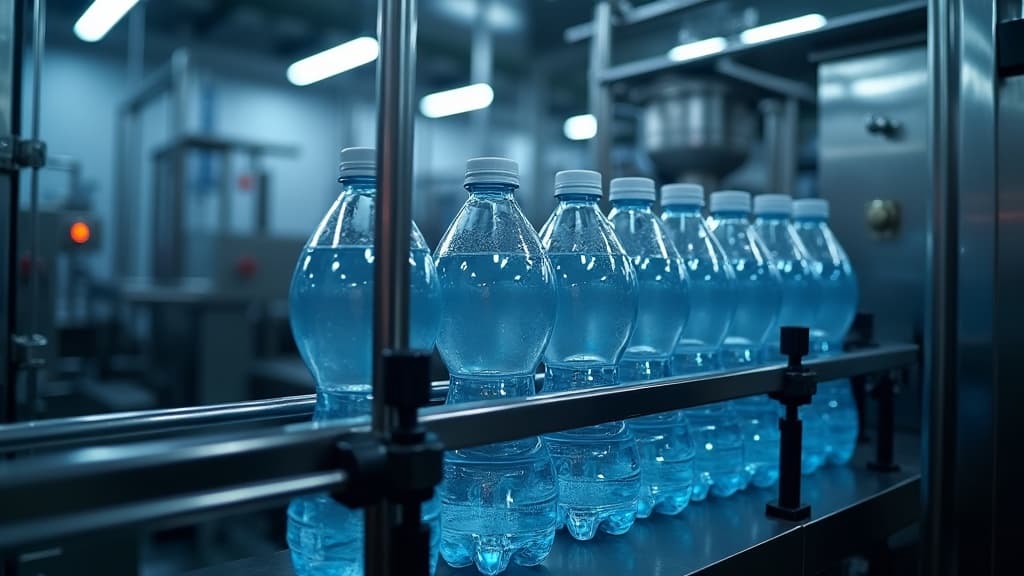
How to Select a Filling and Packaging Line?
The filling and packaging line is the face of your product in the market. A wrongly chosen line means dripping nozzles, crooked labels, and stopped conveyors. The correct choice is hidden in answering three questions: what are you filling, what are you filling it into, and how many units per hour?
1. Product viscosity determines filling technology
- Fluid liquids (water, milk, vinegar): gravity or time-pressure filling
- Medium viscosity (oil, syrup, liquid soap): piston/servo filling
- High viscosity (tomato paste, mayonnaise, honey): piston + product feeding screw
In products with particulates (jam, pickles), nozzle geometry should also be evaluated.
2. Fix the packaging decision
PET bottles, glass jars, cans, and doypacks each require different filling, capping, and labeling equipment. Changing the packaging after setting up the line often means acquiring new machines. Complete market research BEFORE ordering equipment.
3. Choose line speed realistically
If you are targeting 1,000 units per hour, choose a line with a capacity of 1,200-1,500; format changes, label roll changes, and break times reduce theoretical capacity. Line balance rule: the slowest machine is the speed of the line — if filling is 2,000/hour but labeling is 800/hour, your line is 800.
4. Level of automation
Manual feeding + semi-automatic filling makes sense for starting with a low budget. A fully automatic line should be considered together with a bottle sorter, cap feeder, and coding. In markets with high labor costs, full automation pays off quickly.
5. Don’t forget the end of the line
Date coding, case filling, shrink wrapping, and palletizing — "end of line" equipment are the most overlooked items in proposal lists, yet the most sought after in the field.
Example calculation: the real cost of format change
Consider a line that fills two different bottle sizes per day:
- Line speed: 1,500 bottles/hour, shift 8 hours
- Format change: 2 times a day × 25 minutes = 50 minutes downtime
- Lost production: 50/60 × 1,500 = approximately 1,250 bottles per day — approximately 375,000 bottles in 300 production days per year
If a quick change tool-free machine reduces changeover time to 10 minutes, the same line produces approximately 225,000 more bottles per year. The long format change time of a "cheap" machine quietly recovers the price difference.
Technical checklist before proposals
- Products to be filled and viscosity class (liquid / medium / dense / particulate)
- Packaging samples: bottle/jar sizes, mouth diameter, cap type
- Target speed (units/hour) + 2-3 years growth margin
- How many different formats will be filled, how many changes are expected per day
- Level of automation: manual feeding or bottle sorting
- Label type: single face / double face / wrap-around
- Date-lot coding technology (inkjet / laser / thermal)
- End of line: carton, shrink, pallet needs
- Electrical and compressed air infrastructure
Common mistakes
- Creating a business plan with theoretical speed: planning is always below catalog values due to format changes, label rolls, and breaks (see our OEE article).
- Ordering machines without fixing the packaging: a machine cannot be configured for a bottle you DO NOT have; a sample is the first step.
- Excluding the end of line from the budget: a line without a carton, shrink, and pallet station means a manually boxed line at the end — the gains of automation are lost at the door.
- Setting targets that cannot fit into one shift: calculate the labor and management costs of a second shift before increasing the target; sometimes, a larger machine class is more economical.
Logic of return on investment for automation
A manual/semi-automatic line requires low capital but carries labor cost per unit; the opposite is true for a fully automatic line. The decision formula is simple: compare the "total cost per unit" (labor + energy + waste + amortization) of two scenarios at the target volume. At low volumes, semi-automatic almost always wins; as volume increases, the curve intersects. Critical point: do not switch to automation without packaging standardization — irregular production with multiple formats is the greatest enemy of a fully automatic line.
Used machine or new?
When searching for a filling line, used offers may look attractive; ask three questions for clarity in decision-making. First: is the machine configured for YOUR packaging? A second-hand machine is set up for someone else's bottle; if no conversion support is available from the manufacturer for the format set, stars, and nozzles, a "cheap" machine becomes scrap metal. Second: is there spare parts and technical documentation (electrical project, PLC program backup)? A machine with locked programming and lost schematics can be stuck at the first failure. Third: hygiene history — converting a machine that worked with non-food products (chemicals, detergents) back to food is often not economical. General rule: second-hand may make sense in simple, mechanically heavy stations (conveyors, accumulation tables); in precision and hygiene-critical stations like filling-sealing, new + guarantee + FAT is safe.
What to expect during commissioning week?
Set realistic expectations: on the first day, no line will operate at catalog speed. Typical flow includes mechanical installation check, idle running, filling trials with water/placebo, gradual acceleration with real product, and adjustments for weight/tork/label quality. Training your operators on the machine during this week is the main determinant of OEE in the following months. The commissioning protocol (SAT) should be signed by writing the target speed and waste criteria; every adjustment that is postponed to "we will look at it later" becomes permanent when production pressure starts.
Related solutions
- Filling & Packaging Line — complete line with capacity options
- Liquid Filling Line — servo-controlled nozzle filling
- Granule Filling Machine — for dry products like tea, coffee, legumes
- Fully Automatic Labeling and Cap Sealing — stations to be established for line balance
Frequently Asked Questions
Can different bottle sizes be filled on the same line?
Yes; with a format set change. The change time varies from a few minutes to half an hour depending on the machine type.
Machine first or packaging supplier first?
Packaging first. The machine is configured based on the bottle/jar samples in your hand.
Can the number of nozzles be increased later?
Yes, in most linear filling machines; 4 nozzles can be increased to 6-8. Request this flexibility in writing during the proposal stage.
Can glass and PET be filled on the same line?
Yes, in most products; however, conveyor guides, star/format sets, and capping heads must be configured for both.
Share your product and packaging knowledge; let us propose a configuration calculated with realistic capacity and established line balance. "Get a Quote for This Line" takes just a minute.