

Tin Can Production — Automation and Investment Pre-Feasibility
Study at a Glance
- Sector
- Metal packaging
- Country
- Gulf Region
- Capacity
- Fully automatic target: 20,000 cans/day
- Investment Range
- Semi-automatic: 590,000 EUR; fully automatic main line: 2.9–3.3 million EUR
- Study Year
- 2026
Comparison of capacity, personnel, equipment, and investment scope for fully automatic and semi-automatic options for the target of 20,000 cans/day.
Investment Budget
Select a production system to view its main line budget and scope.
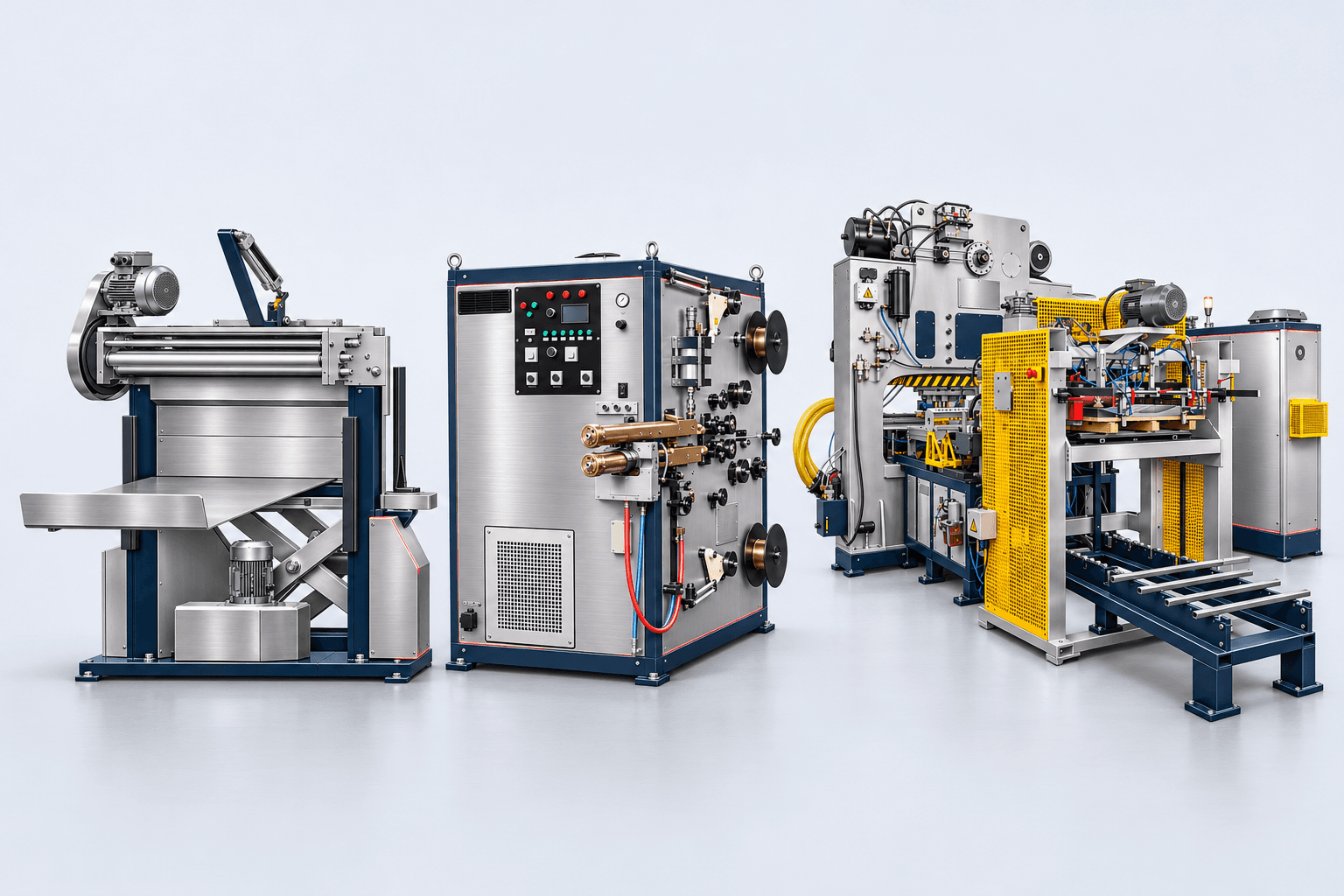
Box drawing, capacity target, press and die sets, body assembly method, operator support level, and product change requirement.
Excluded from this budget
- Painting / printing and drying
- Working capital
Explore the production workflowBody and bottom/lid branches · 8-step interactive demo
How does production proceed?
Select a step to see its input, operation and output.
Body production
Bottom / lid production
G1 · Body sheet preparation
- Input
- Suitable sheet / printed sheet
- Output
- Body blank
- Operation
- Sheet loading, cutting, and transporting to the station are planned with operator support.
- Technical point to confirm
- Sheet thickness, cutting tolerance, roll/sheet start, and cutting equipment scope.
This is a conceptual process diagram; it is not the exact machine layout and sequence. Automatic/operator labels describe the solution approach; they do not count as confirmed technical specifications for each machine. The line does not perform food filling; the production of empty metal packaging is addressed.
The total plant budget cannot be calculated until the responsibility limits for site infrastructure, auxiliary facilities, logistics/tax, and working capital are finalized.
Assumptions & Limitations
This study was prepared under the assumptions below. Results will differ under other conditions.
- Study limitations
- Preliminary feasibility based on discussions. Capacity, scope and financial outcomes require written technical/commercial confirmation. Branded product images are illustrative.
Download the Full Report (PDF)
Leave your e-mail and download the report instantly.
24 pages · PDF
Download the Full Report (PDF) (opens in a new tab)Production video
Frequently Asked Questions
How is the semi-automatic line scope finalized?
The current preliminary sales budget for the semi-automatic / combined system is 590,000 EUR. The final scope is confirmed against the product specification and equipment list. Those determining the budget: Box drawing, capacity target, press and die sets, body assembly method, operator support level, and product change requirement. Separate evaluation: Painting/printing and related drying solution are treated separately. The inclusion/exclusion status of items such as compressor, transfer, installation, training, and transportation should be stated separately. Total plant investment: Building, infrastructure, customs/tax, stock, and working capital are not automatically included in the main line range. Missing items are not accepted as zero. This budget is not the supplier purchase cost. The final price and included equipment will be defined in a binding commercial quotation.
What does the fully automatic budget include?
Pre-sales range for fully automatic main line. The painting/printing group will also be supplied separately. Turnkey approach: Project design, equipment supply, installation, and commissioning. A definitive list of equipment/services, training, and acceptance procedures must be outlined in the proposal annex. Outside the main line: The painting/printing and drying solution related to this process is not included in the main line range. It will be quoted separately based on new/second-hand preference. Those completing total investment: The total plant budget cannot be calculated until the responsibility limits for site infrastructure, auxiliary facilities, logistics/tax, and working capital are finalized. 20,000 boxes/day target is not guaranteed capacity. The range does not include specific delivery conditions or EXW commitment; conditions will be defined in the written proposal.
How many operating hours are needed for 20,000 cans/day?
Producing the daily target in 8 hours requires an average net output of 2,500 cans/hour; in 16 hours, 1,250 cans/hour; and in 24 hours, approximately 833 cans/hour. These are the target divided by operating time, not machine guarantees. Downtime, scrap and planned maintenance must be included in the acceptance criteria. If a speed is already stated as net output, the same losses must not be deducted again.
What do the semi-automatic capacity and 7–8 staffing figures mean?
One semi-automatic solution was stated to produce approximately 3,000–3,500 cans in 8 hours, averaging 375–438 cans/hour. The same discussion estimated 10,000–12,000 units in 24 hours and stated that a single line could not meet the 20,000/day target. Three times the eight-hour range is 9,000–10,500, so the 24-hour figure is retained as a separate estimate. The minimum of 7–8 people comes from a different mixed-line discussion; it is unclear whether shifts, maintenance, quality control and packing are covered. These figures must not be combined to calculate output per person.
What are the seven equipment groups in the production line?
1. Sheet preparation: uncoiling, slitting/cutting and feeding. 2. Body production: welding and forming. 3. Seaming/leak-tight closing: joining the bottom to the body. 4. Bottom, lid and handle: pressing, die and fitting operations. 5. Coating/two-colour printing: sheet surface processing, procured separately. 6. Drying: an application-specific oven; gasket drying and printing drying are different processes. 7. Conveyors/transfer: flow and buffering between stations. This is a functional list, not a confirmed machine count or sequence. Compressors, electrical/compressed-air infrastructure, testing and internal handling must be listed separately.
What are the options for presses, dies and manual production?
Presses, dies and a drying oven formed part of the initial mixed-line discussion; quantities, tonnage, speed and oven function have not been specified. Eccentric presses or presses with pneumatic clutches can be operated with operator assistance. Lid production can be assessed with added feeding/drive arrangements. For a more manual option, identify the changed machine, price impact, cycle time, staffing and protective measures together. The 6–8-month delivery estimate from a separate semi-automatic discussion cannot be applied to other lines.
Why does the choice of coil, sheet and printed lid matter?
A solution starting with sheets is not the same scope as a plant including a decoiler. Coil-fed or sheet-fed options were discussed for unprinted lids; this does not mean the entire line starts from coils or that a decoiler is included in the price. A slit-sheet approach was discussed for printed lids; it requires technical confirmation against the selected printing/coding method. Body feeding and lid feeding must be defined separately.
How will coating/printing and used equipment be assessed?
Tin surface printing and related drying are treated as a separate supply package from the main metal packaging manufacturing line. It is not the same process as lid gasket drying. New system: 3–5 million EUR preliminary budget. The painting/printing and associated drying group is excluded from the main-line price. Colour count, sheet size, print quality and drying conditions are defined separately. Second-hand system: 1–1.5 million EUR preliminary budget for the second-hand painting/printing and drying group. Condition, test printing, overhaul, dismantling, transport and reinstallation scope are assessed separately. Separate budget / separate scope: New and second-hand group budgets are excluded from the main production-line prices. Sheet-printing drying and lid-gasket drying are different processes; scope and acceptance conditions are defined in the written quotation. Output to be purchased: Suitable printed sheet, dried surface, and coating compatible with the product. The input quality criteria for this output are defined separately. The terms printing, metal coating/painting, and gasket drying cannot be used interchangeably. The product requirements must match the supplier's scope.
How do can dimensions and different volumes affect machine selection?
The starting reference is a rectangular oil can with a 240 × 220 mm base. An approximate height of 350 mm was discussed but has not been approved as a final drawing. The market description of 17–18 litres and the request for 20 litres are not the same verified specification. Sheet thickness/coating, lid/handle type and size variants affect cutting, welding, die and transfer compatibility. The number of dies, adjustment/changeover time and additional investment must be assessed for each product. Volumes shown in the illustrations are not technical commitments.
What information is needed to calculate profitability and payback?
Required inputs include can selling price and sales volume; sheet consumption/cost per can and scrap recovery; welding, gasket, handle and printing consumables; energy/compressed-air consumption; shift staffing and fully loaded wages; maintenance, rent and insurance; inventory/receivables terms and financing. Unit contribution equals selling price minus variable costs; break-even quantity equals annual fixed costs divided by positive unit contribution. These inputs are not yet available, so profit and payback have not been calculated. A target of 20,000/day over 200/250/300 working days gives 4/5/6 million cans annually. This is an arithmetic illustration, not a sales forecast.
What concrete steps are needed before an investment decision?
First approve the sample/drawing, sheet specifications and lid/handle requirements. Then define daily operating hours and distinguish net from gross speed. Compare the three automation options against machine lists for the same product. Specify speed, scrap, leak-tightness and changeover criteria for factory/site acceptance. Complete printing, auxiliary systems, site and delivery costs without double counting. Finally, build cash-flow and payback models using local sales, sheet, energy and labour data.