
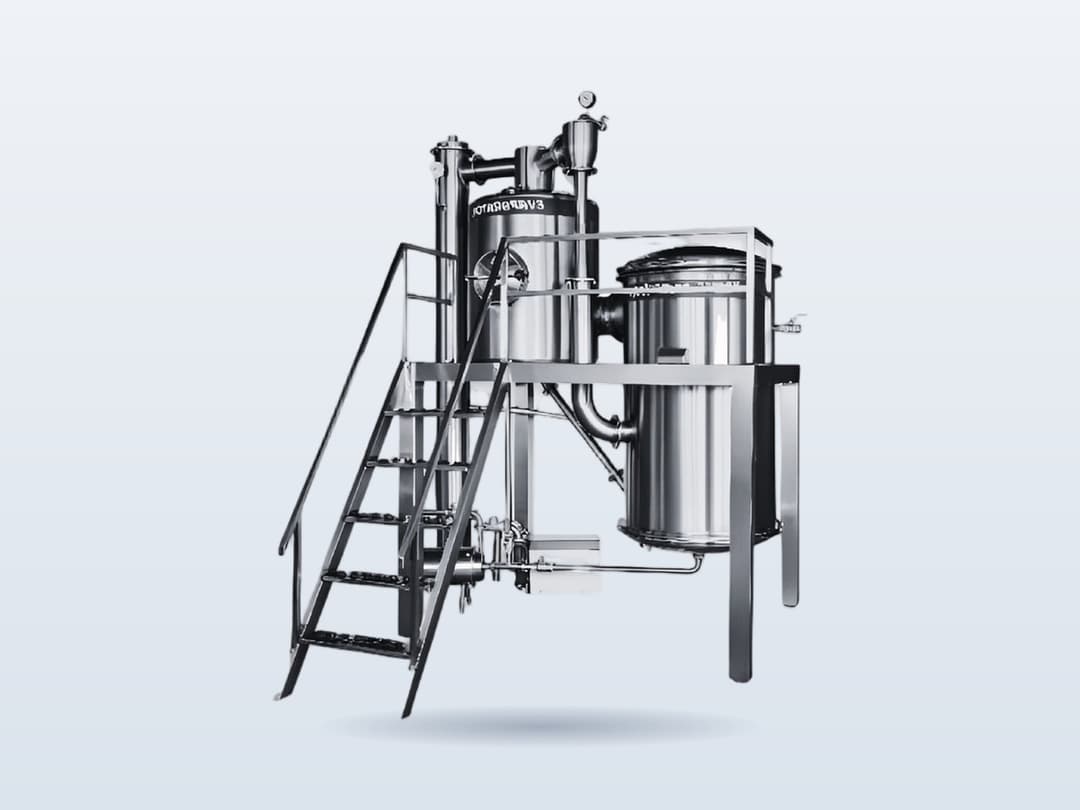
Vacuum Evaporator Selection for a Tomato Paste Plant
The real capacity of a tomato paste line is not set at the crusher or at the filler; it is set at the evaporator. Most of the mass of a tomato is water, and how fast that water can be driven off is what limits, on its own, how many tonnes of fruit the line can swallow in a day.
This article opens one equipment decision rather than the whole plant. For raw material planning, licensing and operating setup, see our tomato paste plant setup guide; what follows is only the vacuum evaporator choice.
What does a vacuum evaporator actually decide in a paste line?
An evaporator drives water out of tomato juice under reduced pressure and carries the product to a target density. Working under vacuum is about temperature rather than speed: as pressure falls the boiling point of water falls with it, so the product concentrates at a lower temperature and losses in colour and flavour stay limited. The target density is not an arbitrary preference either. The Codex Alimentarius standard for processed tomato concentrates (CXS 57-1981) defines tomato purée as a product with natural soluble solids of at least 7 percent and less than 24 percent, and tomato paste as a product carrying at least 24 percent natural total soluble solids. The same standard requires the pH of the product to stay below 4,6, and that threshold underpins the heat treatment and filling decisions that follow. The evaporator is therefore not merely a concentrating device; it is the machine that decides which commercial class your product is sold in. Our vacuum evaporator is configured for a water evaporation capacity of 80 – 190 kg water/hour.
Why is evaporator capacity chosen on water rather than on product?
The figure printed in an evaporator catalogue is not "how many tonnes of paste" but "how many kilograms of water per hour", and that is not a detail — it is the logic of the selection. Most of the weight passing through the line is water; the machine works on that water rather than on the product. Reading capacity correctly needs three inputs: the hourly quantity of tomatoes to be processed, the measured soluble solids of the incoming raw material, and the target product class. Once those three are known, the mass of water to be removed is calculated directly, and the result sizes the evaporator, which in turn sizes the steam boiler and the cooling water demand. The hourly intake comes from the shift plan and not from the calendar: the tomato processing line is configured between 6 – 50 tonnes/day, and processing a 6 tonne daily intake across an eight hour shift means 750 kg of tomatoes per hour. With a delivery time of 14 – 26 weeks, the order is planned backwards from the harvest season.
Single effect or multiple effect — which should be preferred?
In a single effect system the steam is used once. In a multiple effect system the vapour released in the first body heats the next one, so the same kilogram of water is evaporated with less fresh steam. The difference is the classic balance between capital and running cost: as the number of bodies rises the machine and its automation get more expensive while steam consumption falls. What decides the answer is not capacity but annual running time. Tomato processing is seasonal; in a campaign lasting a few weeks a year the return on fuel savings stays limited, while in a plant running a long campaign or reworking concentrate through the year the steam line becomes decisive. A second variable is the energy source, since multiple effect earns its place earlier where gas is expensive or fuel is hard to transport. At small scale compact platform solutions enter instead; the modular tomato paste system, in its standard configuration with a 250 kg/hour pasteurizer, is the example of that band.
Which parts of the line constrain your evaporator decision?
An evaporator is never selected on its own; three stations before and after it either support its size or make it meaningless. The first is the steam side: every kilogram of water removed is a heat load, and if the boiler cannot carry that load the evaporator will never reach its catalogue capacity. The second is the vacuum and condensing side, where the temperature and flow of the cooling water directly set the vacuum level the system can hold — an item routinely underestimated in hot climates. The third is the filling side: whether the concentrate goes into aseptic bags, jars or cans changes both the shelf life and the equipment list. A fourth constraint comes from the front of the line: if the washing, sorting and crushing stations cannot feed the hourly intake, the evaporator idles and the campaign stretches over more days. In small batch production a cooking kettle at 60 – 200 kg/batch handles cooking and blending after concentration, while in can filling the can seaming machine sets the exit speed of the line at 1500 – 3000 cans/hour.
What information do you need to give when requesting an evaporator quote?
The accuracy of a quote rises with the number of constraints you supply. Six headings take an evaporator offer out of the realm of guesswork: daily tomato intake and the number of shifts run during the campaign; the measured soluble solids of the raw material; the target product class and packaging format; existing steam capacity and fuel type; the source, temperature and flow of cooling water; and the certification the destination market requires. These headings are also the data a team building a food safety management system to ISO 22000 will ask for in its first round, so they are not collected twice. Add a seventh heading as well, your campaign calendar: which harvest season the order has to meet shapes the production and shipping plan as much as price does, and where that date is unwritten the lead time turns into an assumption. Write down the site as well: ceiling height and crane access shape the layout of an evaporator with vertically mounted bodies as much as the machine does. Once these are clear the investment band becomes clear too; any figure offered earlier belongs to a configuration nobody can name.
Frequently Asked Questions
How much does an evaporator for a tomato paste plant cost?
An evaporator price cannot be given as a single number, because the machine is the result of a calculation rather than a catalogue item. The main items that set it are the mass of water to be removed per hour, the number of bodies and therefore the energy efficiency target, the design of the vacuum and condensing group, the stainless grade, the automation level and the certification the destination market requires. On top of those sit the campaign length and the existing steam infrastructure, since two systems of identical water capacity call for different solutions when connected to different steam sources. The sound route is to share your daily tomato intake, your raw material brix and your target product class, then ask for a configuration-based pre-assessment. ProcessTürk prepares that per project, so the figure answers a chosen configuration rather than an invented range.
What is the difference between tomato paste and tomato purée?
The difference is a defined boundary rather than a commercial preference. The Codex Alimentarius standard for processed tomato concentrates defines tomato purée as a product with natural soluble solids of at least 7 percent and less than 24 percent, and tomato paste as a product carrying at least 24 percent natural total soluble solids. The line between the two is therefore drawn precisely by the work done in the evaporator: how much water is removed decides which class comes out of the same raw material. The same standard also requires the pH of the product to stay below 4,6. These three figures have to be read together with the labelling rules of your destination market, because the name under which you sell your product depends on the capacity decision you make at the evaporator.
How many tonnes of tomatoes make one tonne of paste?
This ratio is not a fixed coefficient, and treating it as one is the most common source of capacity error. It derives from two measurements: the natural soluble solids of the incoming tomatoes and the solids content of the product class you are targeting. Raw material varies with variety, climate, irrigation regime and harvest timing; differences between batches are measured even within one region in one season. A serious feasibility study therefore starts from measurements taken on real samples from your own supply area, not from a single coefficient lifted out of the literature. Once you hold the measurement the arithmetic is simple, because solids are conserved and only water leaves. The evaporator, the steam boiler and the cooling group are all sized from that one calculation.
Why are evaporator capacity and line capacity not the same thing?
Because the two measure different units. Line capacity counts the raw tomatoes at the intake in tonnes per day, while evaporator capacity states the water removed per hour in kilograms. The bridge between them is the solids content of the raw material, and as that value changes the same evaporator produces different tonnes-per-day figures. If a supplier describes the line in tonnes per day but quotes the evaporator on water, ask which raw material assumption was used to match them; where the assumption is not written down, the figure is not comparable. The second bridge is the shift plan, since the same daily intake can be processed in eight hours or in sixteen, and the hourly capacity required doubles between those two cases. Equalising both assumptions comes before comparing price.
Next Step
Share your daily tomato intake, your raw material solids content, your target product class and your existing steam infrastructure, and let our engineering team prepare a configuration-based pre-assessment. You can open a request from the custom project page or reach us directly through the contact page.