
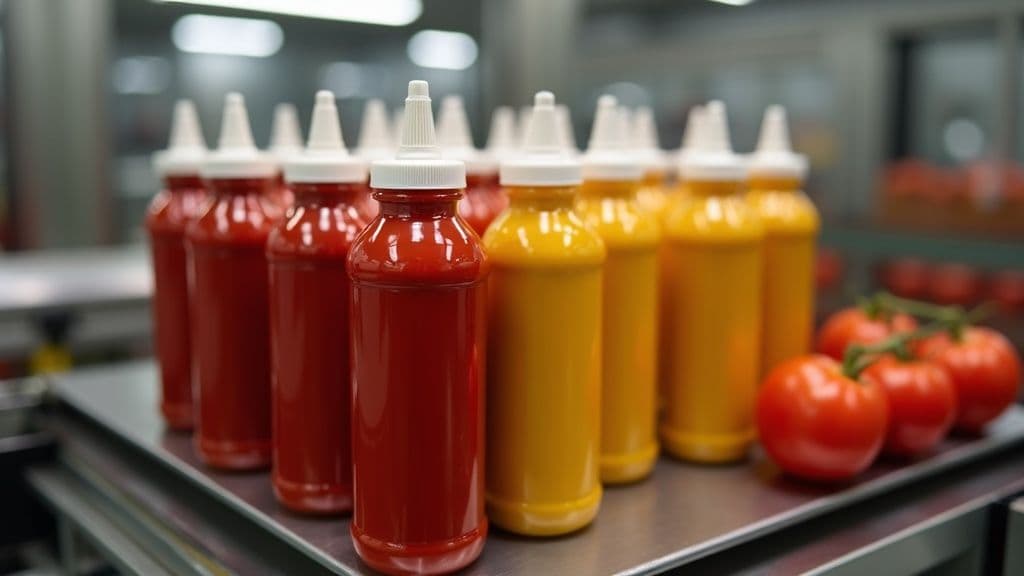
Mayonnaise and Sauce Production Plant for the Gulf Market
In the Gulf states the sauce and mayonnaise shelf is filled largely by imports, while local production shortens both the logistics distance and the exposure to currency swings at the same time. This guide opens the equipment and conformity decisions facing a plant that will serve that market.
For recipes, product range and the general setup of the plant, see our mayonnaise and sauce plant setup guide; what follows deals with the decisions specific to the Gulf.
How is a sauce plant serving the Gulf market laid out?
Sauce production splits into two process families, and the layout of the plant starts from that split. Mayonnaise, salad dressings and cold sauces are prepared without heat treatment: the oil and water phases are brought together under control, the emulsion is built under vacuum and the product goes straight to filling. Ketchup, chilli sauce and cooked sauces instead call for heating, blending and cooling steps. Most plants serving the Gulf begin with a cold line, because the investment is smaller, the product range widens faster and shelf demand runs deeper in cold sauces. A third dimension of the layout is the raw material side: oil tank, vinegar and water line, chilled store for egg product and dry additive store each need separate access. Since most raw material in the Gulf is imported, storage volume is planned larger than in a locally supplied plant. Our sauce production line is configured between 500 – 1.500 kg/hour in its cold configuration, with a delivery time of 17 – 22 weeks and a published quotation band of 153.000 – 278.000 EUR. That band is a line price; as packaging format and automation level change, so does the scope behind it.
What equipment builds a mayonnaise emulsion?
In mayonnaise, product quality is decided by the mixing regime more than by the recipe. Oil, water and egg phases are brought together in a defined order at a controlled rate; a mixer applying high shear reduces the oil droplets while vacuum keeps air out of the product. Air is not merely an appearance problem in mayonnaise: bubbles accelerate oxidation and shorten shelf life. This is why the emulsion tank, the mixer and the vacuum group are selected as one system rather than as three purchases. Emulsion stability is set not only by mixing speed but by the rate at which oil is added: dosed too quickly, the droplets bind before they are fine enough and the product stays prone to phase separation. Mixer speed, vacuum level and oil dosing rate are therefore stored together in one recipe record. Our emulsion mixer tank is configured at a nominal volume of 500 – 5.000 L, while the useful working volume is roughly %80–90 of nominal — a difference frequently missed in recipe calculations. For trials and small batches the compact sauce preparation unit works at 50 kg/batch; validating a recipe in a large tank while entering a market wastes both time and raw material.
Which conformity and certification headings come up in the Gulf?
Food products in the Gulf states fall under a two-layer regulatory field, regional and national. The regional layer is the set of GSO (Gulf Standardization Organization) standards, while the national layer has its own authority in each country, and for Saudi Arabia that authority is the SFDA. A GSO certificate shows that a product meets the regional standard, but it does not replace national approval. Halal certification arises separately for products containing animal-derived material, and mayonnaise sits in the middle of that discussion because egg and some emulsifiers are animal in origin. Who issued the certificate also matters, since authorities accept only the certification bodies they themselves recognise. Labelling belongs to the same file: ingredient list, nutrition declaration and date format are prepared to the language and rules of the destination country, and an Arabic label is expected across most Gulf markets. Those requirements feed back into the label length chosen on the labelling machine. On the hygienic design side, the Codex Alimentarius general principles of food hygiene together with ISO 22000 form the shared frame that acts directly on equipment selection. These headings are not a legal opinion; they are a list of questions to confirm with the relevant authority before the project starts.
How do heat and distribution distance change the design?
In the Gulf, ambient temperature is a process parameter rather than a comfort question. Emulsions are temperature sensitive, and where production hall and warehouse temperatures are not controlled the same recipe yields a different consistency in summer and in winter. Climate control is therefore sized as part of the line and not appended to the end of the equipment list. The cooling water side is planned on the same logic: if condensing and chiller capacities are chosen on a temperate-climate assumption, the target cycle times will not be reached on site. On the distribution side the distances are short and the temperatures high, and shelf life trials that are not run at real distribution temperature produce a product that passes in the laboratory and fails on the shelf. Utilities follow the same rule: adding the cooling load raises the total installed power of the plant noticeably above a temperate-climate assumption, so transformer and generator sizing are done with that load included. Shift planning belongs to the design too, since moving cleaning into cooler hours protects yield and equipment life. For finished goods and raw material storage, cold storage and container systems are configured between 20 – 1000 m³ with a delivery time of 8 – 16 weeks.
How do filling and packaging format change the investment?
In sauce plants the decision that enlarges the equipment list most is not the product but the number of packaging formats. Glass jars, PET bottles, doypacks and portion sachets each call for different filling, closing and labelling machines, so a plant targeting three formats is in fact building three separate exit lines. On the Gulf shelf, retail jars and the large packs going to hotel and catering channels are often demanded together, which is why the format decision is taken alongside the sales channel decision. The format decision shapes the supply chain as much as the machine list: jar lids, doypack film and sachet reel come from different suppliers, each with its own minimum order quantity. A plant starting with three formats is also setting up three separate stock lines. In our catalogue the liquid filling line runs at 500 – 2.500 units/hour and is delivered in 6 – 10 weeks. On the closing side a single-lane system gives 500 – 1.500 units/hour and a twin-lane system 1000 – 2400 units/hour, while fully automatic labelling runs at roughly 10 – 40 units/min depending on container diameter and label length. The real speed of the line is that of its slowest station.
Frequently Asked Questions
How much investment does a mayonnaise plant for the Gulf market require?
The investment cannot be given as a single number, because the scope of the plant moves with the product range and the packaging formats. Our one published reference band is this: for a sauce production line of 500 – 1.500 kg/hour in cold configuration, the quotation band is 153.000 – 278.000 EUR. That band covers the line itself; the building, climate control, cold storage, laboratory, certification and working capital sit outside it and in most projects make up a significant share of the total. Two plants of identical capacity also diverge noticeably when one is built for a single packaging format and the other for three. The sound route is to share your target capacity, product range and packaging formats and ask for a project-based pre-assessment, where the equipment list and the investment band come out together.
Which machines are needed to produce mayonnaise?
The core list is short and reads in sequence: a raw material preparation and weighing station, separate tanks for the oil and water phases, a vacuum high-shear emulsion tank, a buffer tank, a filling machine, a closing machine and labelling. To that are added the clean-in-place circuit, product transfer pumps and finished goods storage. As scale grows the list does not lengthen; the stations become automated instead. Weighing stops being manual, recipe control moves to the panel and filling becomes multi-nozzle. At small scale, several of the same duties merge into one compact unit. The critical point is not the number of machines but the correct selection of the emulsion station, because however well the rest of the line is built, an inadequate emulsion shows as phase separation on the shelf.
Is halal certification mandatory for export to the Gulf?
Halal certification arises in the Gulf states for products carrying animal-derived material, and mayonnaise can fall into that scope because of its egg content. The regional frame is set by GSO standards, while national approval rests with each country's own authority; in Saudi Arabia the SFDA looks for the issuing body to appear on the list it itself recognises. A certificate valid in one Gulf state may therefore not be automatically accepted in another. This is not a formality to be settled after the plant is built, because the origin of the emulsifiers and additives used in the recipe directly determines the outcome of the certification process. What is written here is a list of items to confirm; the final answer comes from the relevant national authority and from a recognised certification body.
Should you choose a cold or a hot process?
The decision follows from the product range rather than from preference. Mayonnaise, salad dressings, tartare and similar emulsion products call for a cold process, since heat breaks the emulsion. Ketchup, barbecue sauce and tomato-based sauces are instead produced through cooking, blending and controlled cooling steps. Choosing one of the two families for the first phase of the plant reduces the investment noticeably and shortens commissioning. If you are targeting both, planning the stations that can be shared — weighing, buffer storage, filling, closing, labelling — as common from the outset comes cheaper than adding a second line later. Taking this decision before the product list is finalised forces a rearrangement of the line afterwards.
Next Step
Share your target capacity, your product range and your packaging formats, and let our engineering team prepare a pre-assessment with an equipment list and an investment band suited to the Gulf market. You can open a request from the custom project page or reach us directly through the contact page.